"My goal in writing music is to express a personal point of view in a manner as emphatic, compelling and universal as possible. I begin with an inclusive approach to material, celebrating diversity, and embracing heterogeneity with all its contradictions. The materials themselves may be coarse grain— possibly entire musical styles—or thin slices cut at a particular angle. In a kind of 'musical genetic engineering,' I recombine these components to create a hybrid musical organism, expressing something of the diverse multi-dimensional and sometimes fractured nature of contemporary identity. Interrelationships, juxtapositions, connections and collisions form the basis of my musical language.
I draw upon sources as diverse as folk musics from around the world, popular music, jazz and historical Western concert music styles; as well as ideas from nature, literature, visual art, science and philosophy. This merging of seemingly incompatible elements, and the dynamic it sets into motion, give rise to the development and structure of my music.
The results are often surprising, yet paradoxically seem to make an intuitive sense, combining sensibility and bold statement, abstraction and everyday objects. In this manner, I seek to create a poetic music, both startlingly new and hauntingly familiar."— David A. Jaffe
Latest News

Projects


Press
Reviews from Musical America, The San Francisco Examiner, etc.
Review of November 11, 2016 Boulder Chamber Orchestra performance of "How Did It Get So Late So Soon?" is on the Sharps & Flatirons web site, a blog by Peter Alexander. Link to review is here. Excerpts below...
This highly personal but unmistakably American work [How Did It Get So Late So Soon?] received a vigorous performance from the orchestra and Pollick, for whom the concerto was written, and by whom it was premiered in Lithuania Aug. 27.
A former bluegrass musician, Jaffe has filled the score with quotes and references to American music from the blues to the protest music of the 1930s. You may not hear the Woody Guthrie song he quotes, but the overall tone will be familiar to American audiences. The blues inflections, the outbreaks of Appalachian fiddling, the folk-tune-like melodies all come from a world we recognize.
There are portions of the concerto that sound as American as anything by Copland. But these ideas are always refracted thought a Charles Ives-ian sensibility, so that the music never settles into an extensive folkish groove. To my ears, that makes it all the more interesting: you never know what will happen next, but it all hangs together in a fascinating mélange. Bravo to Saless and the BCO for programming a work that deserves to be heard widely.
The Baltic Times, the leading English language news source for the Baltic States, published the following review/interview on Sept. 7. 2016, written by Aiste Ptakauske. The original is on-line here.
Selected Writings
Published articles, interviews, etc.
David A. Jaffe (2007, revised 2017)
ABSTRACT: This paper describes the techniques, mappings and algorithms used in the author’s composition “Underground Economy – frameworks for improvisation,” written for the Durán/Schloss/Mitri trio.
Introduction
The goal of the work “Underground Economy” was to create a structured improvisation, in which all three instruments: the piano, the violin and the RadioDrum, are sending data to the computer. The computer then combines these inputs into an electronic audio response. The title of the piece stems from the notion of passing information “under the table” to the computer.
From a compositional standpoint, perhaps the most interesting aspect of the piece was the challenge of writing a fully-improvised piece that has a distinct composer-specified identity, yet leaves a great deal to the musical personalities of the performers. This goal was accomplished by a combination of custom software that describes a series of interactive “schemes” and a score that dictates general directions to the players, such as style, range, dynamics and key center. Thus, the music has an “economy of specification,” another meaning of the title.
This paper describes some of the more novel interactive scenarios that were unique to this work. In addition, the piece builds on Radio Drum solo idioms developed using the Max software environment by Andrew Schloss in his continuing work as a RadioDrum soloist (Schloss, 1990).
Pete Seeger, who died last month, was more than a musician, more than an activist, more then a folklorist. He was a purveyor of hope in the darkest of times. In the McCarthy era, when he was blacklisted, he sang, defiantly, "Wasn't that a time?" and taught music to children. In the 1970s when the Left was imploding, he founded a new cause that transcended the left/right division: cleaning up his own backyard, the Hudson River. He was a fierce believer in political freedom and economic justice. But, while Woody Guthrie's guitar said "This machine kills fascists," the words Seeger wrote on his banjo head read "This machine surrounds hate and forces it to surrender." He was a shy man who could command the stage and perform as no one before or since. While others, like Bob Dylan, sang protest songs as long as it was in fashion, or, like Phil Ochs, struggled internally with a desire to be famous, for Pete, the decision was always clear: do the right thing. When he was finally permitted back on television in the 1960s, he immediately threw caution to the wind and sang "Waist Deep in the Big Muddy," a protest song against the war in Viet Nam.
I grew up with Pete Seeger as a beacon of light. One of the first records I ever heard as a toddler was "Birds, Beasts and Bigger Fishes," with songs like "Leatherwing Bat" and story-songs like "Cumberland Mountain Bear Chase." Our family went everywhere that he performed. Many of these were not "concerts" at all, but political rallies of one form or another. I remember clearly a rally for Mikis Theodorakis, the greek song-writer and activist who was jailed by the military junta in the 1960s. The rally was entirely in Greek, with a translator. Eventually, the translator became so caught up in the emotions of the crowd that he stopped translating and just cheered.
On November 6, 2013, I delivered the Orion Visitor Lecture at the University of Victoria. I discussed my studies with Henry Brant, the early days of computer music at Stanford's Artificial Intelligence Laboratory, the making of Silicon Valley Breakdown, the development of time maps and plucked string synthesis, and my collaborations with Julius O. Smith III, Bernard Mont-Reynaud and others. A complete recording of the lecture is here.
I first met Henry Brant in the late 1970s when I studied composition, orchestration, and 16th century counterpoint with him at Bennington College in Vermont. This eventually led to a thirty-year friendship with discussions of music that have been among the most important in my life.
Henry Brant was unlike any other composition teacher I've ever had in that he offered a meta-perspective on the process of composing. Instead of suggesting that a particular theme should be developed or that a particular note might sound better as a Bb, he taught how to write quickly, how to think hierarchically, how to make deadlines, how to ask for commissions, and how to avoid writers' block. He also was the first to suggest to me that there might be a place in my musical language for the various non-"classical" styles I played, such as bluegrass, klezmer and jazz. This directly led to my writing such works as Silicon Valley Breakdown and Cluck Old Hen Variations.
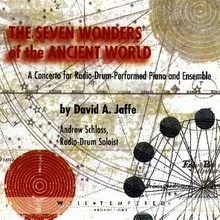
Throughout the years, I have discussed many incipient projects with Henry and invariably he would offer key insights and suggestions that would lead me in fertile directions. As an example, in 1992, I was planning a concerto for RadioDrum-controlled Disklavier piano and large ensemble. I discussed the project with him, including my plan to use a string orchestra. He suggested I instead employ an ensemble of plucked strings. When I pressed him to elaborate, he suggested mandolin, guitar, harp, harpsichord, harmonium, bass and two percussionists. This became the seventy-minute work, "The Seven Wonders of the Ancient World,” premiered by the San Francisco Contemporary Music Players in 1998. Such interactions were always at the very start of a project. Then, at the conclusion, I would play him the result, he would offer his thoughts and then ask "what next?"
This article describes the "maximalist" approach I take in my musical composition. This approach embraces heterogeneity and allows for complex systems of juxtapositions and collisions, in which all outside influences are viewed as potential raw material. I focus here on the notion of hybridization, in which two or more sharply-defined and highly-contrasting aspects of experience are combined to produce something that is both alien and strangely familiar. Recent technological advances have allowed hybridization to extend into the realms of the synthesis of sound itself, the ensemble relationship between musical lines and the connection between performer and instrument.
This brief essay chronicles some of my shuttlings between the domains of music and nature, and looks closely at examples from three different genres: instrumental music, vocal music, and computer music. More generally, it illustrates the compositional strategy of starting from the known, in this case bird song and behavior, and abstracting to the unknown. The familiar, whether it be a musical style, a bird song or a computer-simulation of the human singing voice, is already something of great richness and character. The process of abstraction then involves combining several familiar elements in an unconventional manner, or stretching the familiar in strange directions or to unnatural proportions. The result can be something quite alien, but with a strong hauntingly-familiar identity, as if viewing a face from a long-forgotten childhood dream.
Use of bird song can be viewed as one example of "external" artistic inspiration that, far from the popular view of a passive experience that overcomes an artist, involves active molding and sculpting of raw material into something new. In taking such an inclusive approach, the artist has, quite literally, the world to gain. Paradoxically, when he or she allows private personal experience to find its way into music, the result can be more broadly relevant, compelling work.
Featured Albums
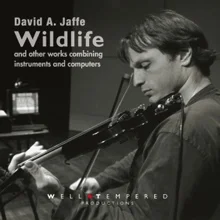

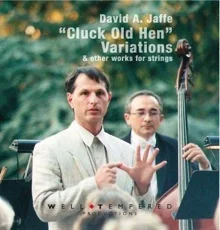
Who's on First? for five double-basses
Cluck Old Hen Variations for solo violin
Quiet Places for string quartet
Havana Dreams for chamber ensemble
Whoop For Your Life! for orchestra